
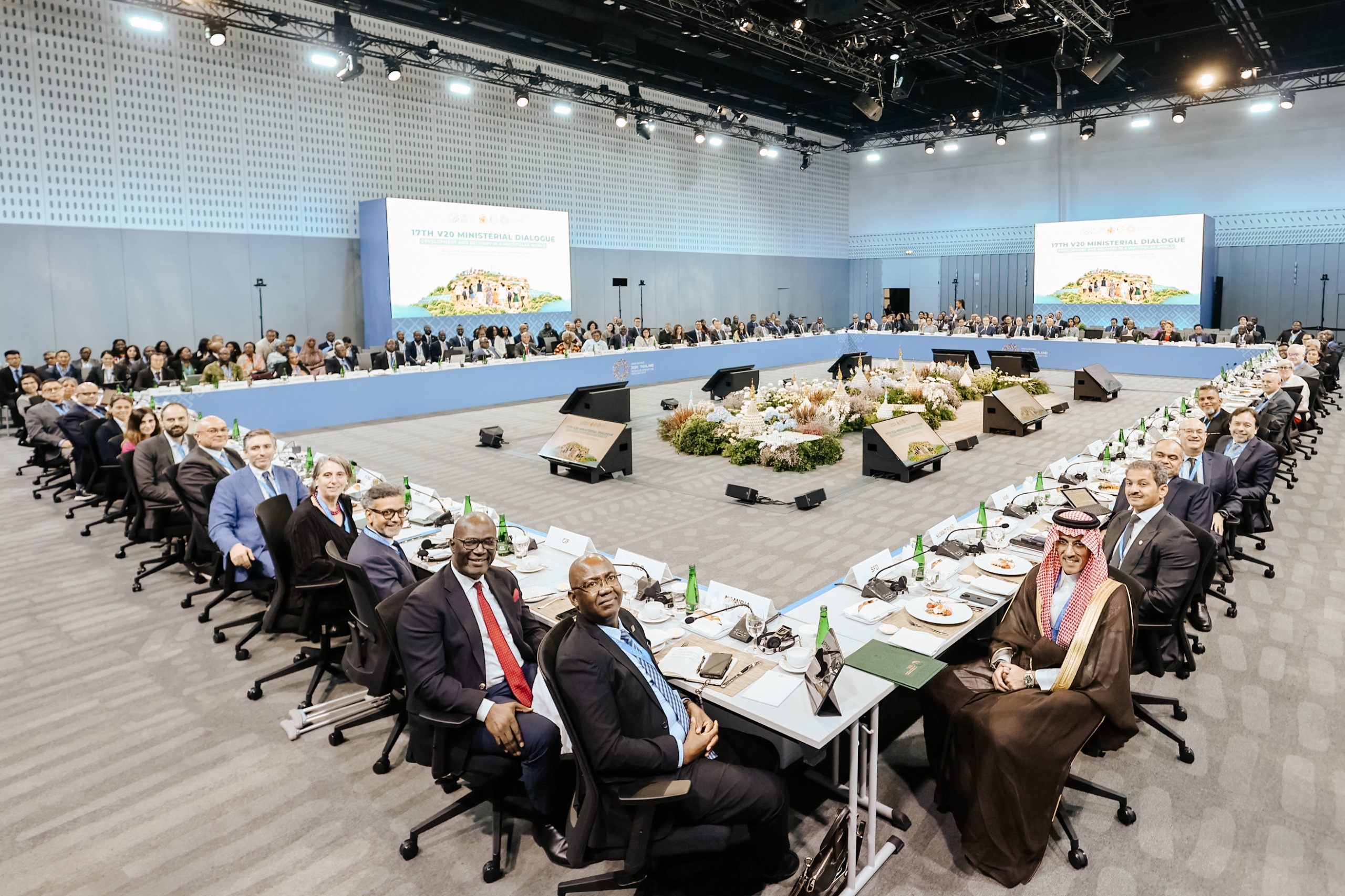
Bangkok, Thailand—Finance ministers representing 77 economies most affected by disasters today called for a pivot on resilience by prioritizing investments in education, health, and clean water. Ministry officials of economies vulnerable to climate change said they are operating under six interconnected constraints, namely sovereign debt distress, low investment rates, high borrowing costs, repeated energy and climate shocks, and lower growth. V20 Ministers issued a statement saying “inaction in one drastically constricts potential in others, narrowing fiscal space, raising the cost of capital, and limiting the ability to invest in the very things that would break the cycle.”
The climate-vulnerable country call was issued as new analysis showed nine in ten assessed V20 countries are outside the more favorable low debt-risk category of the International Monetary Fund (IMF) and World Bank Debt Sustainability Framework.
V20 Ministers said “The financing gap our countries face collectively is not simply one of scale but of structure. It is most acute where resilience and economic transformation converge, spanning water, health, education, and value addition, and where investment must simultaneously establish infrastructure, strengthen institutions, and build domestic capability.”
The V20’s ranks grew to 77 as ministers welcomed the Central African Republic, the Republic of Zambia, and Saint Vincent and the Grenadines as the newest members of the CVF-V20, broadening its reach across Africa and the Caribbean.
Meeting on the margins of the 2026 IMF and World Bank Group Annual Meetings, V20 Finance Ministers adopted the 17th V20 Communiqué and agreed on the next phase of the Vulnerability to Viability (V2V) Compact, which targets concessionality, private capital mobilization, country ownership, and shock-responsive financing, launched earlier in June with 16 development finance institutions.
The ministers called for a harmonization of tenors and pricing across concessional finance windows, and broader eligibility for climate-vulnerable economies, vowing to detail strategic measures in greater granularity in a forthcoming V2V paper.
WIth incessant rains and recent floods that inundated the Bangkok metropolis as their backdrop, ministers mandated the establishment of a capital mobilization team within the CVF-V20 Secretariat to convert Compact commitments into investable transactions. V20 officials invited more development finance institutions (DFIs), bilateral agencies, philanthropies, and partner governments to join their initiative.
The communiqué called on DFIs, including multilateral development banks (MDBs) and vertical funds, to publish standardized, comparable information on pricing, tenor, and grace periods in a single accessible format as well as differentiated financing products for middle-income countries, including those emerging from debt restructuring.
Ministers also called for expanding the scope of climate-resilient debt clauses to cover hazards experienced by CVF-V20 members while providing comprehensive coverage to all of their borrowers.
“Courage means reforming the global financial architecture so that adequate financing reaches low-income and small, climate-vulnerable states for critical investments in education, health, and clean water,” the communiqué stated.
Finance Ministers expressed grave concern over the findings of the Fourth Edition of the V20 Debt Review.
The study found that out of the 48 V20 members eligible for the IMF’s Poverty Reduction and Growth Trust (PRGT) assessed under the Debt Sustainability Framework, five (5) are in debt distress, 17 are at high risk, 22 are at moderate risk, and only four are at low risk. This means roughly nine countries in ten are outside the low-risk category.
Debt-service pressures are also mounting. In 2024, 25 members spent 10 to 20 percent of government revenue on external debt service, while eight spent 20 percent or more.
“To ensure long-term growth, V20 countries need lower borrowing costs, longer maturities, and timely debt treatments. While debt swaps have returned to the discussion as useful tools, they only provide partial relief. Debt swaps should not obscure the need for a broader debt relief strategy and coordinated restructuring,” said Barbados Finance Minister Ryan Straughn. “Ultimately, reforming the global financial architecture and sustaining international financial flows remain key, alongside improving domestic financing conditions,” he added.
Ministers welcomed efforts of the V20 Central Bank Governors to operationalize the Lifeline Fund, the first multi-regional financial arrangement designed to provide rapid liquidity to CVF-V20 countries when climate shocks translate into balance-of-payments needs.
In her remarks, Barbados Prime Minister Mia Amor Mottley called on ministers to join the Lifeline Fund as founding members. She called on members of the G7, G20, and the philanthropic community to help capitalize the fund. “When the next shock comes, and we know it will, we should not have to start negotiating from zero. We should already have the Lifeline in place,” Mottley said.
The communique concluded with an emphatic reminder to the ministerial’s participants: “The architecture for success exists, the evidence for it is settled, and our partnership is hereby formed and cemented. What remains is the courage to deliver for all of us. History is not made by promises. History is made by delivery.”
***
The CVF-V20 now represents 77 member countries from small island developing states (SIDS), least developed countries (LDCs), low to middle-income countries (LMICs), landlocked developing countries (LLDCs), and fragile and conflict-affected states (FCS). Working together, the CVF-V20 aims to achieve climate justice through the realization of Climate Prosperity Plans, which contain ambitious economic and financial resilience strategies designed to attract investment and resources that advance the attainment of the Sustainable Development Goals (SDGs), 30×30 Global Biodiversity, and help keep the average global temperature within the Paris Agreement’s 1.5°C safety threshold.
Africa: Benin, Burkina Faso, Cabo Verde, Central African Republic, Chad, Comoros, Côte d’Ivoire, Democratic Republic of the Congo, Eswatini, Ethiopia, Gabon, The Gambia, Ghana (Troika), Guinea, Kenya, Liberia, Madagascar, Malawi, Morocco, Mozambique, Namibia, Niger, Rwanda, Senegal, Sierra Leone, Somalia, South Sudan, Sudan, Tanzania, Togo, Tunisia, Uganda, Zambia
Asia: Afghanistan, Bangladesh (Troika), Bhutan, Cambodia, Jordan, Kyrgyzstan, Lebanon, Maldives, Mongolia, Nepal, Pakistan, Palestine, Philippines, Sri Lanka, Timor-Leste, Vietnam, Yemen
Caribbean: Barbados (Chair/Troika), Dominica, Dominican Republic, Grenada, Guyana, Haiti, Saint Lucia, Saint Vincent and the Grenadines, Suriname, Trinidad and Tobago
Latin America: Colombia, Costa Rica, Guatemala, Honduras, Nicaragua, Paraguay
Pacific: Fiji, Kiribati, Marshall Islands, Nauru, Palau, Papua New Guinea, Samoa, Solomon Islands, Tonga, Tuvalu, Vanuatu
For media enquiries, please contact [email protected].
For the latest updates, please follow us on: