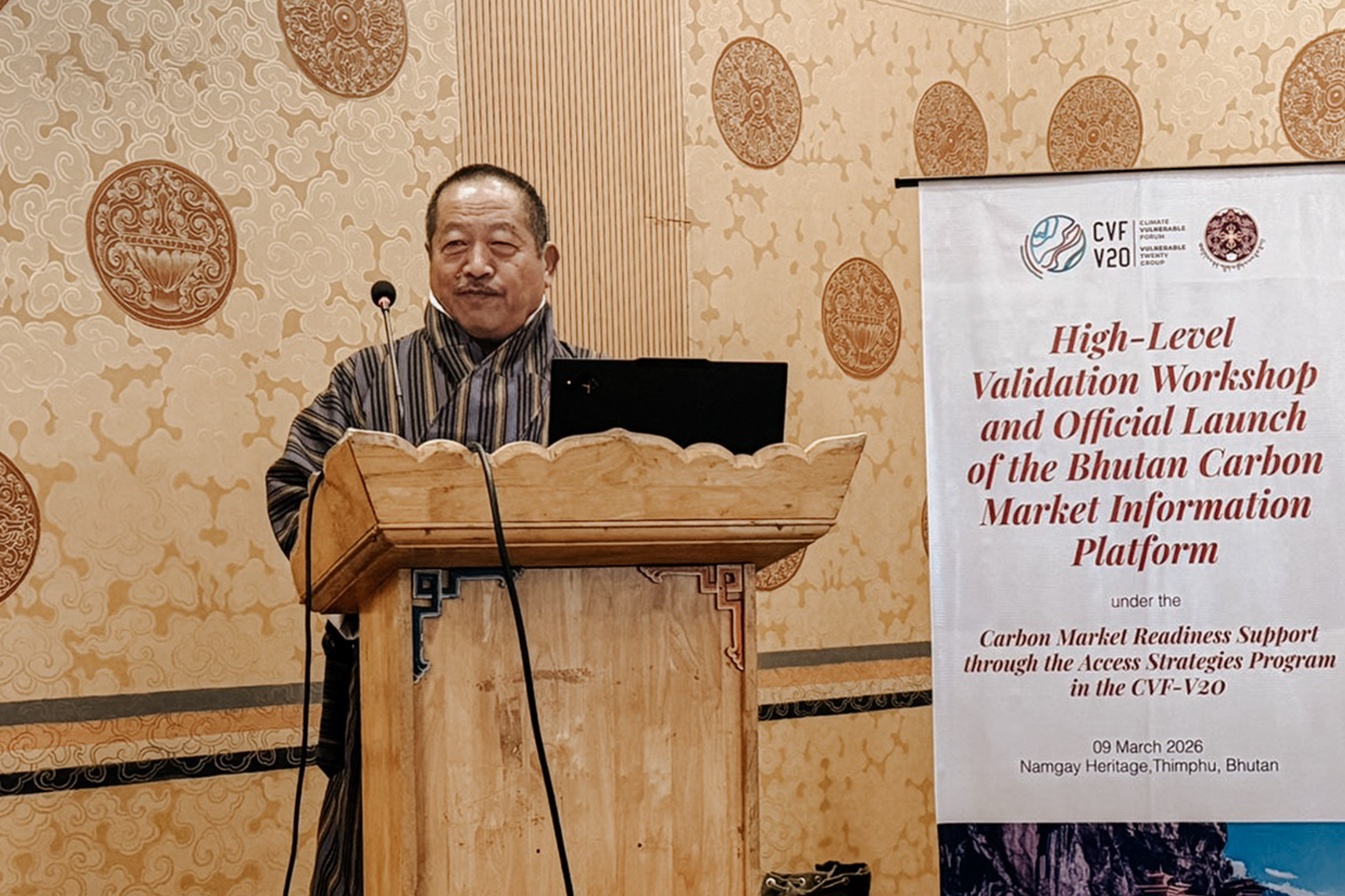
Through the Carbon Finance Program, Bhutan has accelerated the development of policy frameworks and strengthened the institutional foundations needed to advance the country’s participation in carbon markets, including the launch of a centralized carbon information platform.
The Bhutan Carbon Market Information Platform consolidates the country’s policies, procedures, and project development resources into a single hub, helping to improve efficiency, strengthen transparency, and enhance investor confidence in engaging with Bhutan’s carbon market. This positions Bhutan not only as a country with high ambitions on carbon markets, but one that is ready for investment, anchored in high-integrity frameworks. With the relevant political frameworks and institutional mechanisms in place to boost a positive list of carbon market activities, Bhutan gears towards harnessing its market potential of at least USD 100 million.
“This is not simply an information portal—it is part of Bhutan’s market access architecture, designed to enhance transparency, reduce transaction costs, and strengthen carbon credit integrity. It also reflects a core element of Bhutan’s strategy: enabling strong private sector participation,” Sara Jane Ahmed, Managing Director and V20 Finance Advisor of CVF-V20 Secretariat, explained during the launch on 06 March 2026.
The launch of the Platform, through the Ministry of Energy and Natural Resources, under the leadership of H.E. Lyonpo Gem Tshering, is part of the Carbon Finance Program, delivered in collaboration between the CVF-V20 Secretariat and the Voluntary Carbon Markets Integrity Initiative (VCMI). The Carbon Finance Program supports climate-vulnerable member states in leveraging high-integrity carbon markets as a supplementary revenue stream to finance their Climate Prosperity Plans—multi-phase national strategies for investment and technology access designed to transform climate risks into bankable opportunities.
“Bhutan is one case study of how the Carbon Finance Program has enabled countries to build the framework needed to attract carbon credit finance. We will be supporting countries on the supply side of the project development, validation, verification, adapting finance, making sure the legal frameworks are fit for purpose, but also engaging with buyer countries,” said Mark Kenber, Executive Director of VCMI, during the 16th V20 Senior Officials Meeting held on 16 March 2026.