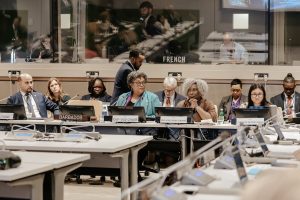
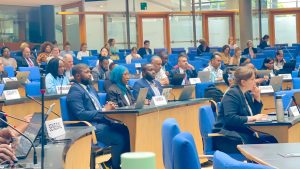
London, United Kingdom—In the margins of the Global Partnership Conference, the Climate Vulnerable Forum-V20 Finance Ministers (CVF-V20) Secretariat, Global Capacity Building Coalition (GCBC), and the Foreign, Commonwealth, and Development Office co-hosted a roundtable to discuss implementable reforms to support country platforms and other country-led approaches.¹
Discussion converged around a clear message: country-led approaches are critical to advancing climate and development objectives. However, the ability of platforms to deliver at scale depends on systemic reforms² and new ways of working across the architecture to improve collaboration and coherence. It’s time we move beyond existing vague calls for action towards a limited number of priority reforms across institutions that are specific, actionable, and politically feasible. Country platforms are viewed as a practical route to strengthen collaboration, reduce fragmentation and support more effective partnerships over time.
Participants identified country ownership, strong cross-ministerial leadership and coordination (particularly between finance ministries, centers of government and relevant sectoral ministries) and patient, programmatic support as critical to effective country-led approaches. Whilst many partners already have plans that could underpin a country platform, there remains a gap between national priorities and the development of bankable projects capable of attracting public and private investment. Closing this gap requires development actors to invest in existing national institutions and systems to enable countries to move from planning to implementation on their own terms.
Participants saw MDBs, VCEFs, and DFIs as essential partners in country platforms, with important roles across finance, technical assistance, convening power, policy support, and private capital mobilisation. To maximise their impact, these institutions should work more closely with local actors, including national development banks, to engage private finance earlier, build stronger investable pipelines, and connect domestic capital markets with larger pools of international capital.
Participants highlighted how stronger coordination and coherence between MDBs, VCEFs and DFIs enabled conditions for effective country-led approaches, particularly in areas such as project preparation and capacity building. Priorities for improvement included greater interoperability, harmonisation, simplification and streamlining, alongside faster and more accessible support, particularly for the most climate-vulnerable countries. It is the responsibility of the international community to address this challenge and more must be done to operationalise existing reform agendas.
London Climate Action Week offers a timely opportunity to take this conversation forward, with a focus on engaging private finance and considering the many ways country platforms can support enabling environment reform and private capital mobilisation.