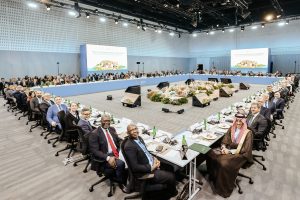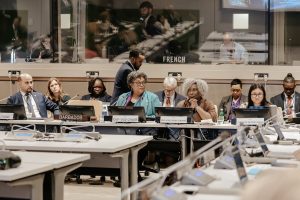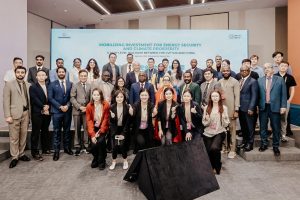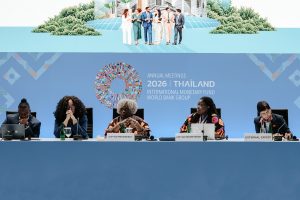

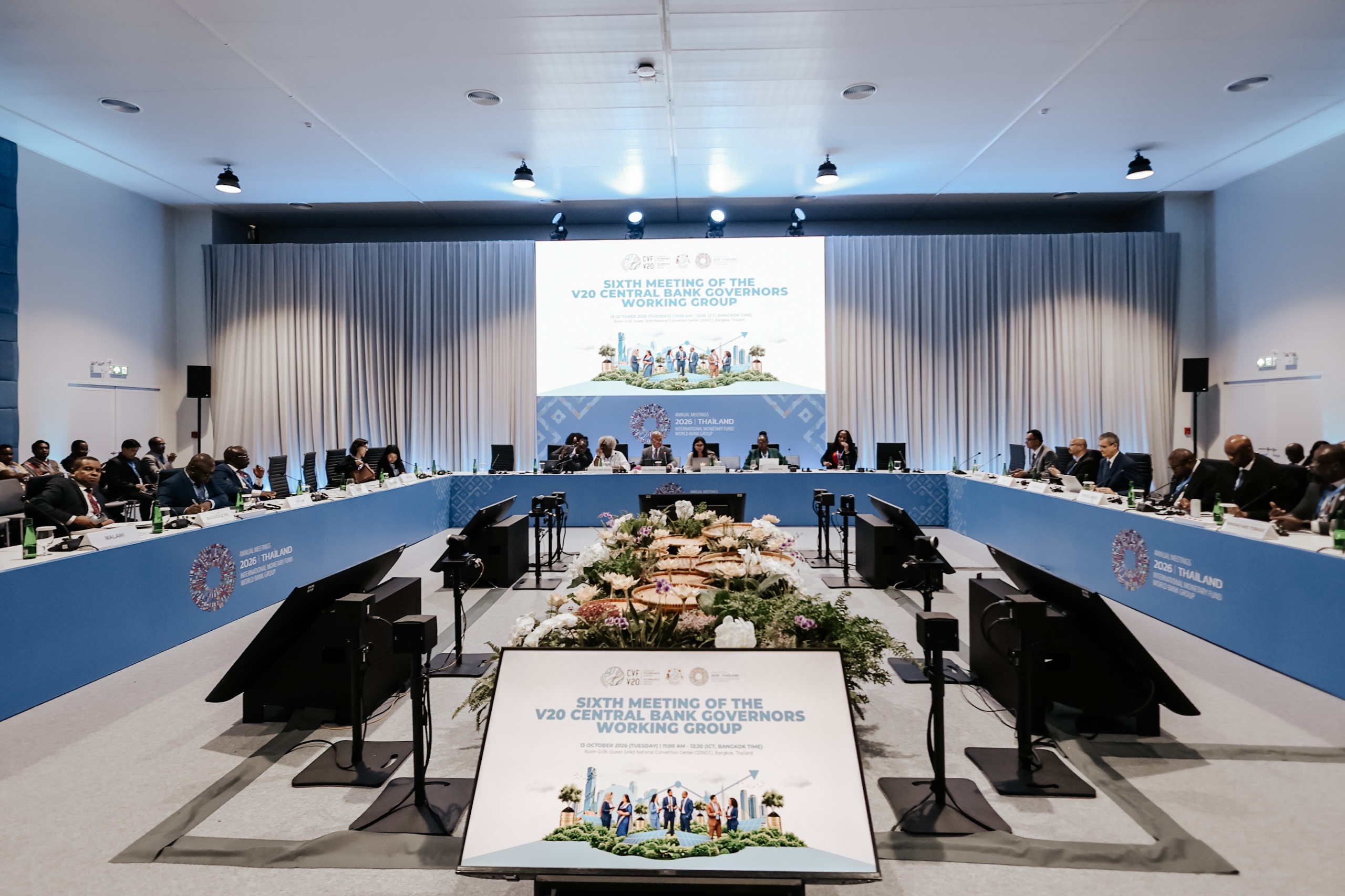
Bangkok, Thailand—At the Sixth Meeting of the V20 Central Bank Governors Working Group, held at the Queen Sirikit National Convention Center during the 2026 Annual Meetings of the World Bank Group and IMF, central bank governors from climate-vulnerable countries signed a non-binding Statement of Endorsement expressing their interest in participating in the establishment of the Lifeline Fund, a proposed climate-focused multi-regional financial arrangement designed to provide rapid liquidity support when climate shocks translate into balance-of-payments pressures.
Barbados, Bhutan, The Gambia, Ghana, Guyana, and Papua New Guinea signed the Statement of Endorsement, with additional countries expressing support pending completion of domestic approval processes.
The Statement is deliberately non-binding. It does not commit any central bank to join the Fund, nor does it commit reserves or any other financial resources. Signatories affirm the need for a V20-owned, multi-regional financial arrangement capable of providing rapid liquidity following climate shocks; support the principal design direction developed collectively through the Working Group; and express an interest in participating in the establishment of the Fund, subject to each institution’s domestic processes.
The meeting took place against the backdrop of intensifying climate risks across vulnerable economies. The current strengthening El Niño, expected to persist into 2027, illustrates the potential for climate-related disruptions to place pressure on economic activity, external balances, and financial buffers. Papua New Guinea, which has accessed the IMF’s Resilience and Sustainability Facility, highlighted the need for responsive instruments capable of addressing immediate pressures on international reserves and foreign exchange markets following climate shocks.
The Lifeline Fund addresses a structural gap in the Global Financial Safety Net (GFSN). There is no dedicated mechanism for providing fast, predictable balance-of-payments support following a climate shock. For the majority of V20 members, there is uneven access to currency swaps and regional financial arrangements. Existing IMF rapid instruments are limited in size and not pre-arranged, while longer-term facilities were not designed for immediate post-shock liquidity and carry broader programme requirements.
Upon establishment, the Lifeline Fund would become the first climate-focused multi-regional financial arrangement within the GFSN, spanning the Caribbean, Africa, Asia, Latin America, and the Pacific. Its design was developed through direct engagement with V20 central banks, including four focused technical consultations, a high-level technical meeting in Bridgetown, Barbados, in July 2026, and subsequent stress testing and bilateral engagement. At the CVF Leaders’ Meeting in September 2026, Leaders welcomed progress toward establishing Lifeline and mandated completion of the technical, legal, and institutional work necessary to bring the Fund into operation.
The Fund’s design centres on two lending facilities:
The Rapid Resilience Facility (RRF) provides short-term liquidity after climate-triggered shocks, with disbursement linked to a qualifying climate event and a maturity of one to three years.
The Stabilisation Credit Facility (SCF) supports medium-term balance-of-payments adjustment arising from climate shocks, with a maturity of three to five years.
Based on the initial capitalisation and stress-testing results, the Fund is expected to begin operations with the Rapid Resilience Facility, with the Stabilisation Credit Facility to be introduced as the Fund’s capital base and lending capacity expand, subject to the appropriate governance approvals.
The initial operational capitalisation objective is US$500 million, with a pathway to at least US$1.6 billion as membership and partner participation expand. For planning purposes, indicative member contributions have been estimated at the equivalent of 0.2 percent of international reserves; actual subscriptions remain subject to domestic approval. The Fund’s capital structure is designed to be strengthened over time through additional member and partner contributions, retained investment income, and potential borrowing from international capital markets, subject to appropriate governance decisions and risk management safeguards.
Chaired by Dr., The Most Honourable Kevin Greenidge, F.B., Governor of the Central Bank of Barbados and Chair of the V20 Central Bank Governors Working Group, the meeting advanced the operational pathway toward establishment. Governor Greenidge said:
“When a climate shock creates sudden balance-of-payments and liquidity pressures, climate-vulnerable economies should have access to financial support that arrives at the speed the shock requires. That is the problem Lifeline is intended to address. We have now shown that climate-vulnerable countries can build a financial safety net designed for the shocks we actually face. The task before us is to build it.”
Next steps. The Working Group will now complete the remaining technical and legal work on the draft Governing Instrument, including outstanding questions concerning reserve-asset treatment, access arrangements, pricing, and financial risk management. The objective is to have the founding instrument ready for signature by the 2027 Spring Meetings of the World Bank Group and IMF. Entry into force and the first Board of Governors meeting will follow once the conditions established in the founding treaty are satisfied. Establishment preparations will also include interim reserve-management arrangements, host-country arrangements, transitional governance, and the competitive selection of the permanent Executive Director.
***
The CVF-V20 now represents 77 member countries from small island developing states (SIDS), least developed countries (LDCs), low to middle-income countries (LMICs), landlocked developing countries (LLDCs), and fragile and conflict-affected states (FCS). Working together, the CVF-V20 aims to achieve climate justice through the realization of Climate Prosperity Plans, which contain ambitious economic and financial resilience strategies designed to attract investment and resources that advance the attainment of the Sustainable Development Goals (SDGs), 30×30 Global Biodiversity, and help keep the average global temperature within the Paris Agreement’s 1.5°C safety threshold.
Africa: Benin, Burkina Faso, Cabo Verde, Central African Republic, Chad, Comoros, Côte d’Ivoire, Democratic Republic of the Congo, Eswatini, Ethiopia, Gabon, The Gambia, Ghana (Troika), Guinea, Kenya, Liberia, Madagascar, Malawi, Morocco, Mozambique, Namibia, Niger, Rwanda, Senegal, Sierra Leone, Somalia, South Sudan, Sudan, Tanzania, Togo, Tunisia, Uganda, Zambia
Asia: Afghanistan, Bangladesh (Troika), Bhutan, Cambodia, Jordan, Kyrgyzstan, Lebanon, Maldives, Mongolia, Nepal, Pakistan, Palestine, Philippines, Sri Lanka, Timor-Leste, Vietnam, Yemen
Caribbean: Barbados (Chair/Troika), Dominica, Dominican Republic, Grenada, Guyana, Haiti, Saint Lucia, Saint Vincent and the Grenadines, Suriname, Trinidad and Tobago
Latin America: Colombia, Costa Rica, Guatemala, Honduras, Nicaragua, Paraguay
Pacific: Fiji, Kiribati, Marshall Islands, Nauru, Palau, Papua New Guinea, Samoa, Solomon Islands, Tonga, Tuvalu, Vanuatu
For media enquiries, please contact [email protected].
For the latest updates, please follow us on: