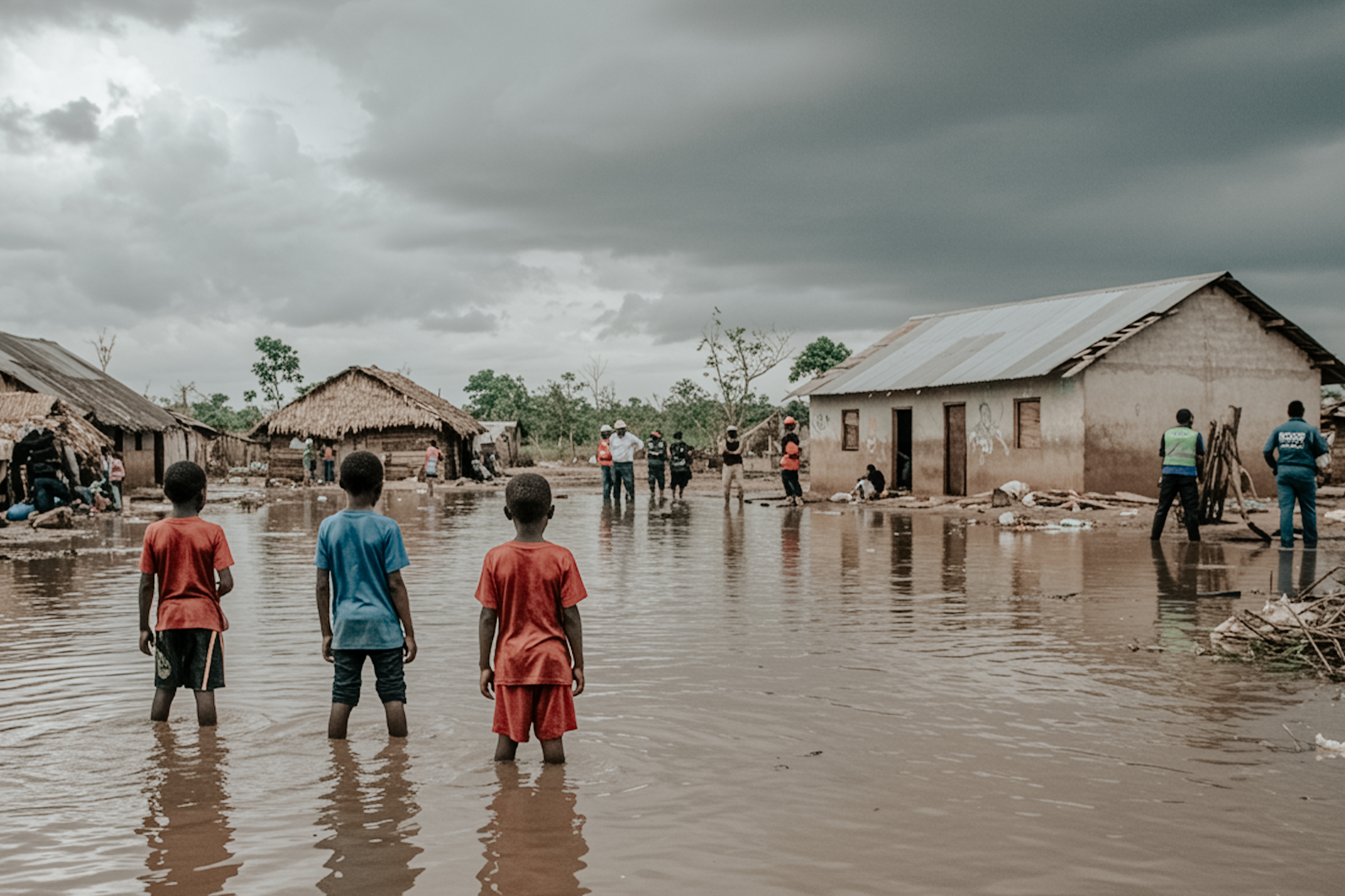
In Mozambique today, children are paying the price for a crisis they did not create.
Recent floods and cyclones have displaced more than 720,000 people, destroyed schools and health facilities, and disrupted access to food and clean water, overwhelmingly affecting children and families already struggling with poverty and climate risk. These weather extremes are not isolated events: they reflect a relentless rise in climate-driven shocks.
Mozambique’s experience is part of a broader pattern. Across Africa, the Pacific, the Caribbean, and parts of Asia, countries least responsible for climate change are facing the greatest impacts. According to the United Nations Refugee Agency, weather-related disasters have caused 220 million internal displacements over the last ten years, equivalent to approximately 60,000 displacements per day.
This is a humanitarian imperative — but also a systemic finance problem.
Vulnerable countries face the highest costs of adaptation and recovery despite having the lowest share of cumulative global greenhouse gas emissions. The 2025 UNEP Adaptation Gap Report revealed that developing nations will need around USD 310 billion to USD 365 billion per year by 2035 to prepare for the impacts of climate change. Yet actual adaptation finance delivered today is only a fraction of that figure.
This financing gap is not abstract. It directly shapes how countries respond to crises like Mozambique’s. Without affordable, reliable access to financing tools that protect public budgets against climate risk, nations are forced into a cycle of emergency appeals, short-term borrowing, and diversion of scarce resources from health, education, and long-term resilience investments.
This is where coalitions such as the CVF-V20 are indispensable.
The CVF-V20 brings together more than 74 climate-vulnerable countries across Africa, Asia, Latin America, the Caribbean, and the Pacific. Its mission is to promote climate finance approaches that enhance resilience and reduce fiscal volatility. Central to this are Climate Prosperity Plans, strategic, economy-wide frameworks for adaptation, mitigation, and economic transformation.
Importantly, the CVF-V20 promotes risk finance solutions, including sovereign risk pooling and insurance mechanisms. Regional risk pools, such as the African Risk Capacity (ARC), Caribbean Catastrophe Risk Insurance Facility (CCRICF), Pacific Catastrophe Risk Insurance Company (PCRIC), and Southeast Asia Disaster Risk Insurance Facility (SEADRIF) collectively provide risk coverage for many vulnerable nations. But these instruments often lack sufficient capital and concessional backing, limiting their scale and affordability.
While these risk pools exist, they cannot yet reach the capital depth required to protect all vulnerable member states, a shortfall made clear in recent extreme weather events. That is why global partners must step forward with predictable, long-term funding that enables these instruments to function at scale.
Beyond national risk pools, organizations such as Climate Resilience for All are demonstrating how locally focused adaptation strategies—from cooling centers to heatwave preparedness and community-based resilience programs—can protect the most vulnerable populations, particularly women, who experience disproportionate climate impacts.
But structural change requires finance that is adequate, predictable, and timely.
Success will depend on embedding protective financial mechanisms into national planning rather than treating climate resilience as an annual afterthought. Development insurance, if capitalized appropriately with concessional layers, pooled risk, and multi-year commitments, can serve as core financial infrastructure, reducing the need for emergency borrowing and enabling faster, more stable responses to climate shocks.
What could this mean in practice?
- Automatic liquidity triggered by predefined thresholds, eliminating delays inherent in post-disaster appeals.
- Multi-year capital buffers that lower pricing volatility and make protection affordable.
- Pooled risk structures that diversify risk across countries and regions, stabilising costs.
- Concessional layering that brings private capital into global risk markets while ensuring vulnerable countries can pay for coverage.
This is not theoretical. Elements of this architecture are being explored through high-level expert consultations on risk financing frameworks that aim to elevate development insurance from the periphery of climate finance to its core.
Mozambique’s children should not have to rebuild their lives every few years because financial systems remain reactive and under-resourced. Emergency response saves lives, but resilience finance saves futures.
If global investment matched the scale of adaptation needs outlined by the World Bank and UN, countries like Mozambique would have a fighting chance to protect their people from the worst impacts of climate change.
The crisis in Mozambique is a warning signal to the world; when climate risk is predictable, the global financial architecture must also be predictable, capitalized, and equitable.
The time to close the resilience gap is now, before the next storm becomes the defining story of another generation.