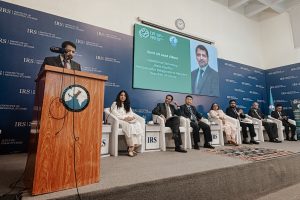
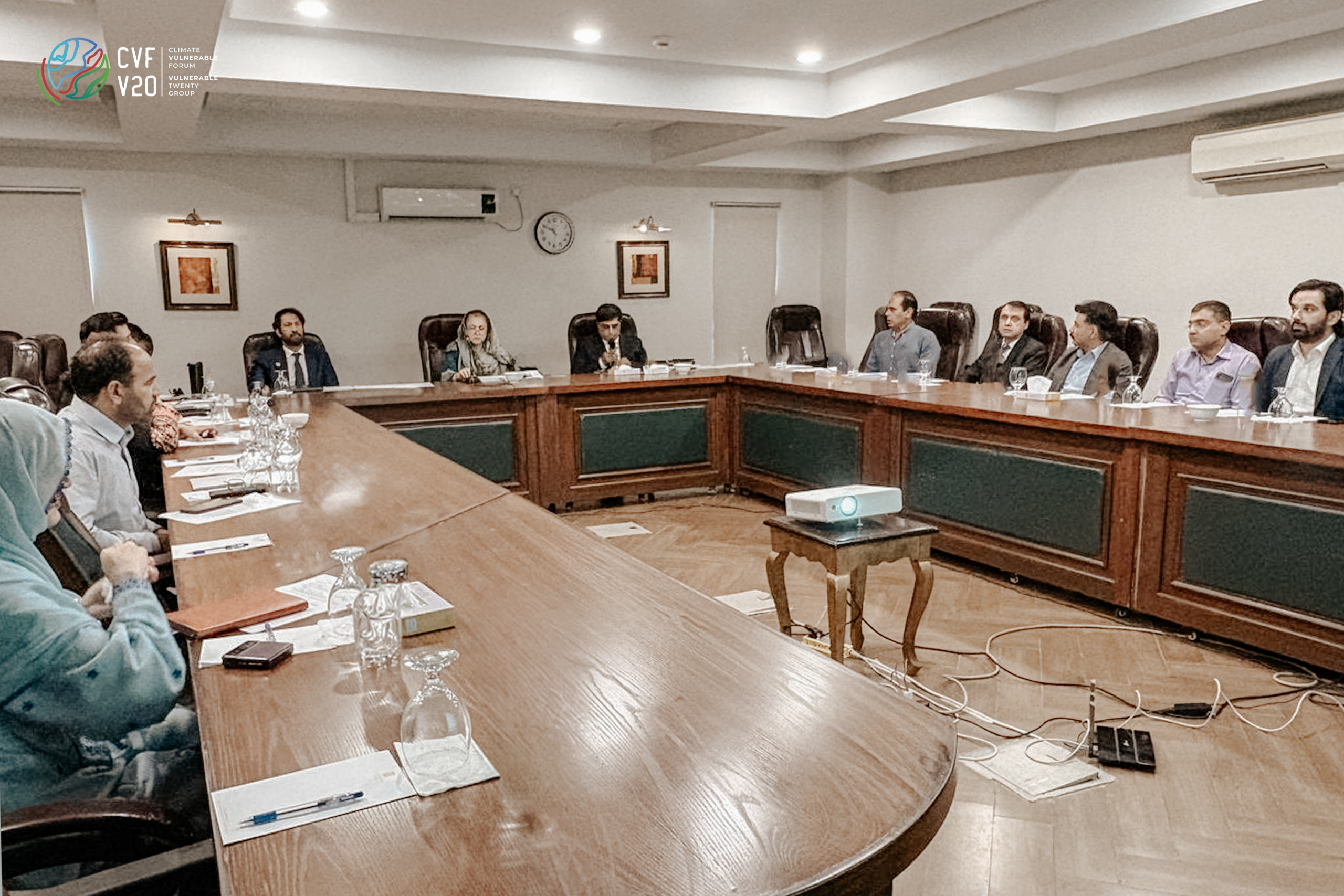
Pakistan’s Ministry of Climate Change & Environmental Coordination (MoCC&EC) convened federal and provincial governments on May 14 to align the country behind a single delivery agenda, positioning the country’s Climate Prosperity Plan (CPP) as the vehicle for turning its climate commitments into investable projects and bankable financing partnerships.
During the event, the CVF-V20 Secretariat presented the CPP as the core delivery instrument for Pakistan’s Nationally Determined Contribution (NDC) 3.0 commitments and green growth, translating national climate targets into investment-ready projects, financing pathways, and implementation mechanisms. Participants from provincial governments reviewed opportunities for coordination on climate-resilient development, project pipelines, and climate finance mobilization.
The CVF-V20 stressed that the CPP does not introduce a parallel framework. Rather, it operationalizes existing national and sectoral policies and frameworks, including the NDC 3.0, the National Adaptation Plan (NAP 2023), the National Biodiversity Strategy and Action Plan (NBSAP), URAAN Pakistan, and the Green Taxonomy.
The scale of the opportunity is significant. The CPP outlines US$1.6 trillion in investment needs through 2050. To make that figure actionable, it includes an Investor Book featuring 69 projects already worth over US$4.85 billion, spanning eight (8) priority sectors: climate-resilient agriculture, energy optimization and just transition, EV industry and transportation, circular economy, resilient infrastructure, nature-based solutions, green economic zones, and financial protection. These are structured, investable opportunities ready for financing conversations today.
Central to the discussion was the proposed Pakistan Country Platform: a coordinated delivery mechanism jointly anchored by the Ministry of Finance and MoCC&EC, with participation from provincial governments, development partners, multilateral development banks, and the private sector, and designed to embed a whole-of-government, whole-of-society approach into Pakistan’s climate investment agenda.
Translating that architecture into action requires provinces to play an active role. The consultation concluded with three concrete asks: that each province nominate a dedicated focal person for CPP coordination, identify additional provincial projects for inclusion in the CPP pipeline, and actively support the development of the Country Platform. Taken together, these steps are designed to ensure that provincial priorities are not just represented in the CPP but drive it.
At the conclusion of the session, Ms. Aisha Humera Chaudhry, Secretary of the Ministry of Climate Change & Environmental Coordination, requested that CVF-V20, along with the MoCC&EC, co-organize similar CPP consultations and workshops at the provincial level across all provinces. The Secretary also proposed joint investor roadshows with CVF-V20 to strengthen provincial engagement and mobilize additional climate investments.
The consultation reaffirmed Pakistan’s commitment to a prosperity-driven climate development pathway in which federal ambition and provincial action are joined by a shared implementation architecture.