
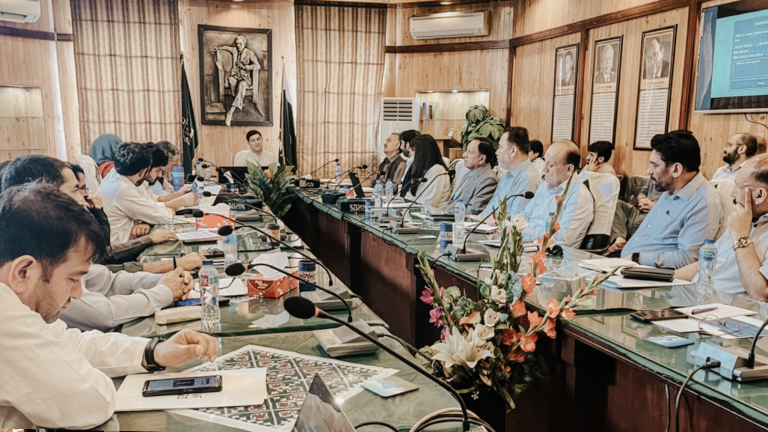
Gilgit-Baltistan, Pakistan | July 18, 2025—As part of its nationwide efforts to develop a robust Climate Prosperity Plan (CPP), Pakistan has expanded consultations to Gilgit-Baltistan, a region deeply affected by the impacts of climate change.
The Climate Vulnerable Forum and V20 Finance Ministers (CVF-V20) Secretariat visited Gilgit-Baltistan from July 22 to 23 to engage with local stakeholders, identify scalable climate investment opportunities, and ensure the region’s inclusion in both national strategies and international climate finance frameworks. The Secretariat delegation included Hamza Haroon (Regional Director, South Asia), Anam Rathor (Program Lead, Pakistan CPP), and Zeshan Masood (Coordination Officer, South Asia). The visit was hosted by the Planning and Development Department (P&DD) of Gilgit-Baltistan.
The consultations kicked off with a high-level roundtable at the P&DD, chaired by Raja Nasir Ali Khan, Gilgit-Baltistan’s Minister of Planning and Development. The Minister facilitated in-depth discussions with senior officials from key departments, including forestry, environment, agriculture, livestock, fisheries, disaster management, local government, and rural support programs.
The discussion highlighted Gilgit-Baltistan’s acute climate vulnerabilities, ranging from glacier retreat and extreme weather events to limited participation in global climate forums and restricted access to climate finance. Local officials shared a diverse portfolio of initiatives already underway in the region, including glacier protection programs, clean energy transition plans, women and youth skill-building centers, organic food branding, and zero-plastic initiatives. A central theme of the meeting was the need for stronger federal-provincial coordination to ensure Gilgit-Baltistan’s climate priorities are fully embedded in Pakistan’s national CPP.
At the Gilgit-Baltistan Environmental Protection Agency (GB-EPA), the delegation reviewed several innovative environmental programs, such as PET bottle return systems, Women’s Green Business Centers, and real-time climate monitoring networks.
The team also visited Karakoram International University (KIU) to explore ways to integrate science-based research into climate policy and planning. Discussions covered the application of GIS mapping, glacier grafting, hazard vulnerability risk assessments (HVRAs) across 16 valleys, and gender-inclusive climate education. CVF-V20 and KIU are currently finalizing a Memorandum of Understanding (MoU) to strengthen collaboration on early warning systems, student-led research, and the alignment of university data outputs with national climate risk frameworks.
Focused consultations were also held with the Aga Khan Rural Support Programme (AKRSP), which is implementing projects on carbon offsetting, climate-resilient agriculture, and energy efficiency across the region. The team reviewed successful pilots on agroforestry, tree plantation, clean cooking technologies, and village-level awareness campaigns. In parallel, engagement with the Gilgit-Baltistan Rural Support Programme (GBRSP) centered on scaling up community-led adaptation solutions. These included indigenous seed banks, infrastructure for Glacial Lake Outburst Flood (GLOF) risk reduction, and inclusive microfinance models targeting women entrepreneurs.
Across all engagements, institutions in Gilgit-Baltistan demonstrated a strong commitment to climate innovation and resilience. The CVF-V20 Secretariat will continue working closely with local officials to ensure the region’s climate ambitions are fully reflected in the national CPP.
***
The CVF-V20 represents 74 member-countries from small island developing states (SIDS), least developed countries (LDCs), low-to-middle income countries (LMICs), landlocked developing countries (LLDCs), and fragile and conflict-affected states (FCS). Working together, the CVF-V20 aims to achieve climate justice through the realization of Climate Prosperity Plans, which contain ambitious economic and financial resilience strategies designed to attract investment and resources that advance the attainment of the Sustainable Development Goals (SDGs), 30×30 Global Biodiversity, and help keep the average global temperatures to the Paris Agreement’s 1.5°C safety threshold.
For media enquiries, please contact [email protected].
For the latest updates, please follow us on:
Africa: Benin, Burkina Faso, Cabo Verde, Chad, Comoros, Côte d’Ivoire, Democratic Republic of the Congo, Eswatini, Ethiopia, Gabon, The Gambia, Ghana (Troika), Guinea, Kenya, Liberia, Madagascar, Malawi, Morocco, Mozambique, Namibia, Niger, Rwanda, Senegal, Sierra Leone, Somalia, South Sudan, Sudan, Tanzania, Togo, Tunisia, Uganda
Asia: Afghanistan, Bangladesh (Troika), Bhutan, Cambodia, Kyrgyzstan, Maldives, Mongolia, Nepal, Pakistan, Philippines, Sri Lanka, Timor-Leste, Vietnam
Caribbean: Barbados (Chair/Troika), Dominica, Dominican Republic, Grenada, Guyana, Haiti, Saint Lucia, Suriname, Trinidad and Tobago
Latin America: Colombia, Costa Rica, Guatemala, Honduras, Nicaragua, Paraguay
Middle East: Jordan, Lebanon, Palestine, Yemen
Pacific: Fiji, Kiribati, Marshall Islands, Nauru, Palau, Papua New Guinea, Samoa, Solomon Islands, Tonga, Tuvalu, Vanuatu