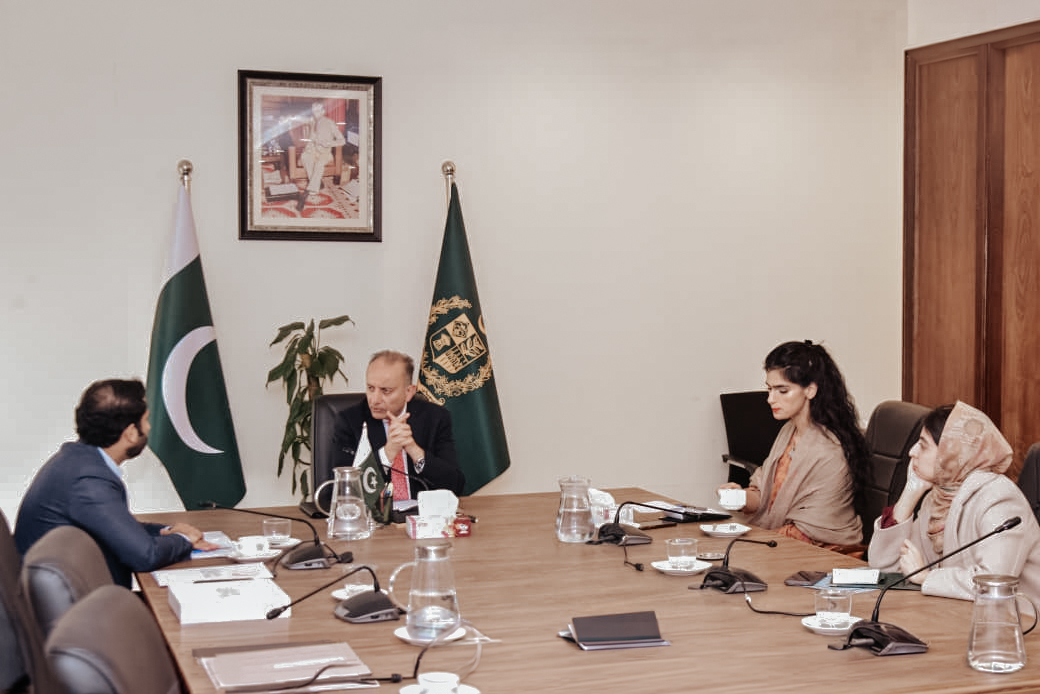
The CVF-V20 Secretariat met with Pakistan’s Minister for Climate Change, H.E. Dr. Musadik Malik, on January 8 to align on how CVF-V20 tools and approaches can support national decision-making and delivery on climate and economic priorities. The discussion focused on positioning the Green Economy Model–Prosperity (GEM-P) as a practical, evidence-based tool for the Prime Minister’s Task Force, alongside advancing the launch and implementation of Pakistan’s Climate Prosperity Plan (CPP).
Hamza Ali Haroon, Regional Director South Asia, highlighted that GEM-P provides a dynamic, systems-based framework to help policymakers assess and compare reform options—including tariffs, subsidies, grid upgrades, and decentralized energy—while clearly capturing macro-fiscal, growth, and resilience impacts. The model also enables the government to stress-test assumptions related to economic growth, foreign exchange exposure, demand trends, and climate shock risks, supporting more informed and forward-looking policy decisions.
Building on this analytical foundation, the discussion underscored how the CPP translates model outputs into a sequenced and costed portfolio of priority reforms and investments. Designed as a delivery-oriented framework rather than a standalone strategy, the CPP supports ministries in moving from targets to implementable, finance-ready actions by linking economic planning, climate resilience, and investment priorities.
Three core areas of alignment were identified during the meeting. First, technical and capacity support to embed GEM-P within government through structured training and the establishment of a dedicated Pakistan team, enabling officials to independently run scenarios and brief senior leadership as part of a sustained capability-building effort. Second, policy alignment to support the CPP’s approval and launch as an economic and fiscal delivery framework, positioning it not only as a climate plan but as a tool to reduce long-term fiscal and macroeconomic risks from climate shocks. Third, the importance of a clear delivery mechanism through a Country Climate Delivery Platform to coordinate institutions, prepare projects, mobilize finance, and track results without creating parallel structures.
The meeting reflected a shared commitment to moving from ambition to implementation by strengthening analytical capability, institutional coordination, and delivery capacity, with CVF-V20 supporting Pakistan’s efforts to firmly anchor climate action within economic planning and public investment decisions.