
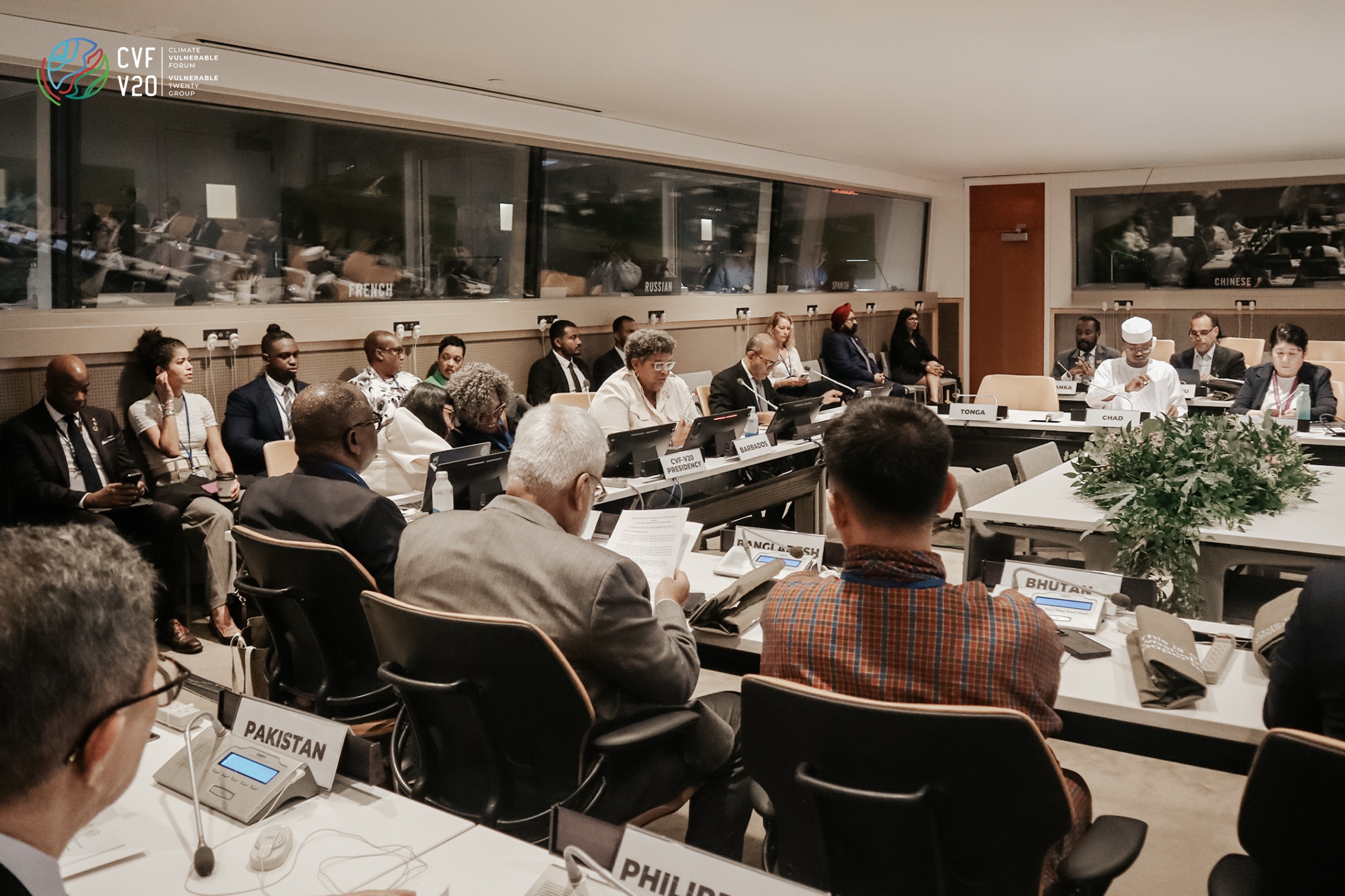
New York City—Noting that the world has now “hurtled past” the 1.5°C limit of the Paris Agreement, leaders of the Climate Vulnerable Forum and V20 Finance Ministers (CVF–V20), representing 74 nations and 1.8 billion people, today issued a strong call for adaptation financing to help vulnerable developing countries cope with the massive climate impacts that are now unavoidable.
In particular, CVF-V20 ministers and heads of government, meeting on the sidelines of the 80th Session of the United Nations General Assembly (UNGA 80) in New York, committed to work hard for a comprehensive Adaptation Package at COP30—anchored in prosperity, affordable long-term finance, technology access, and strengthened national institutions—to close the adaptation gap and secure a resilient future for the most climate-exposed nations.
Leaders noted that the world was above 1.5°C for all of 2024, and stressed that the climate crisis is a driver of structural and systemic macroeconomic and financial instability. Specifically, climate change shocks are compounded by inflexible debt and high servicing costs, which drain fiscal space and constrain the ambition and ability of many nations to invest in the adaptation and resilience urgently needed to protect their people and economies.
The CVF-V20 calls for urgent steps to strengthen delivery, expand access to affordable, long-term finance for adaptation, resilience and economic transformation. Leaders emphasised that multilateral development banks (MDBs) and development finance institutions (DFIs) must scale up concessional lending to rates below countries’ medium-term GDP growth rates.
“With the world having passed 1.5 degrees and the imminent threat this poses to our countries, we must now mobilise the adaptation finance needed to tackle the hurricane of climate damages that will follow. We must reshape a global financial system that is too slow, delivers too little, and burdens the next generation with the cost of today’s delays. It is not enough to pledge more finance or declare new commitments. What matters is scale, acceleration and delivery,” H.E. Mia Amor Mottley, Prime Minister of Barbados and Chair of the Barbados CVF-V20 Presidency, emphasised during the meeting.
The CVF Leaders Meeting took place against the backdrop of the landmark International Court of Justice (ICJ) Advisory Opinion, which affirmed that all countries have binding obligations to act ambitiously to limit global warming.
A Flawed System Penalises the Vulnerable
The CVF-V20’s demands are backed by data from the Global Emerging Markets (GEMs) risk database, which reveals a significant flaw in how risk is assessed. The data shows that low-income countries have a real default rate of just 6.3%, yet their sovereign ratings imply a much higher risk of 14.2%. A similar distortion is seen in lower-middle-income countries, where the real default rate is 4.4% but market price risk is at a staggering 14.6%.
These distortions inflate borrowing costs and discourage private investment, essentially forcing the nations least responsible for emissions to pay the highest price for adaptation. The leaders declared that this unjust system must end, framing their declaration as a roadmap to turn climate vulnerability into economic prosperity.
Key Outcomes from the Leaders’ Declaration
Call for a Global Methane Agreement
Prime Minister Mottley also urged CVF-V20 nations to support rapid emissions reductions, particularly through a global methane agreement. She stressed that such measures could significantly reduce global emissions without threatening key fossil fuel or livestock sectors.
“I suggest that if CVF member countries were to support a global methane agreement, we could lower global emissions to all our benefit, stop the rising heat levels and buy ourselves more time,” Prime Minister Mottley said. “More specifically, such an agreement must recognise that our agriculture and livestock sectors should stand to be the first beneficiaries of access to finance, technology, and transition support” she added.
Next Steps
CVF–V20 leaders committed to carrying the Declaration into upcoming global processes, including the 30th Session of the Conference of the Parties (COP30) to the UNFCCC in Belém, Brazil, reform of the international financial architecture, and ongoing negotiations on climate finance, debt solutions, and representation in international institutions.
“Our call is clear: justice, finance, and resilience for the most vulnerable are not optional—they are the foundation of global stability and prosperity,” the Declaration concludes.
***
The CVF-V20 represents 74 member-countries from small island developing states (SIDS), least developed countries (LDCs), low-to-middle income countries (LMICs), landlocked developing countries (LLDCs), and fragile and conflict-affected states (FCS). Working together, the CVF-V20 aims to achieve climate justice through the realization of Climate Prosperity Plans, which contain ambitious economic and financial resilience strategies designed to attract investment and resources that advance the attainment of the Sustainable Development Goals (SDGs), 30×30 Global Biodiversity, and help keep the average global temperatures to the Paris Agreement’s 1.5°C safety threshold.
For media enquiries, please contact [email protected].
For the latest updates, please follow us on:
Africa: Benin, Burkina Faso, Cabo Verde, Chad, Comoros, Côte d’Ivoire, Democratic Republic of the Congo, Eswatini, Ethiopia, Gabon, The Gambia, Ghana (Troika), Guinea, Kenya, Liberia, Madagascar, Malawi, Morocco, Mozambique, Namibia, Niger, Rwanda, Senegal, Sierra Leone, Somalia, South Sudan, Sudan, Tanzania, Togo, Tunisia, Uganda
Asia: Afghanistan, Bangladesh (Troika), Bhutan, Cambodia, Kyrgyzstan, Maldives, Mongolia, Nepal, Pakistan, Philippines, Sri Lanka, Timor-Leste, Vietnam
Caribbean: Barbados (Chair/Troika), Dominica, Dominican Republic, Grenada, Guyana, Haiti, Saint Lucia, Suriname, Trinidad and Tobago
Latin America: Colombia, Costa Rica, Guatemala, Honduras, Nicaragua, Paraguay
Middle East: Jordan, Lebanon, Palestine, Yemen
Pacific: Fiji, Kiribati, Marshall Islands, Nauru, Palau, Papua New Guinea, Samoa, Solomon Islands, Tonga, Tuvalu, Vanuatu