
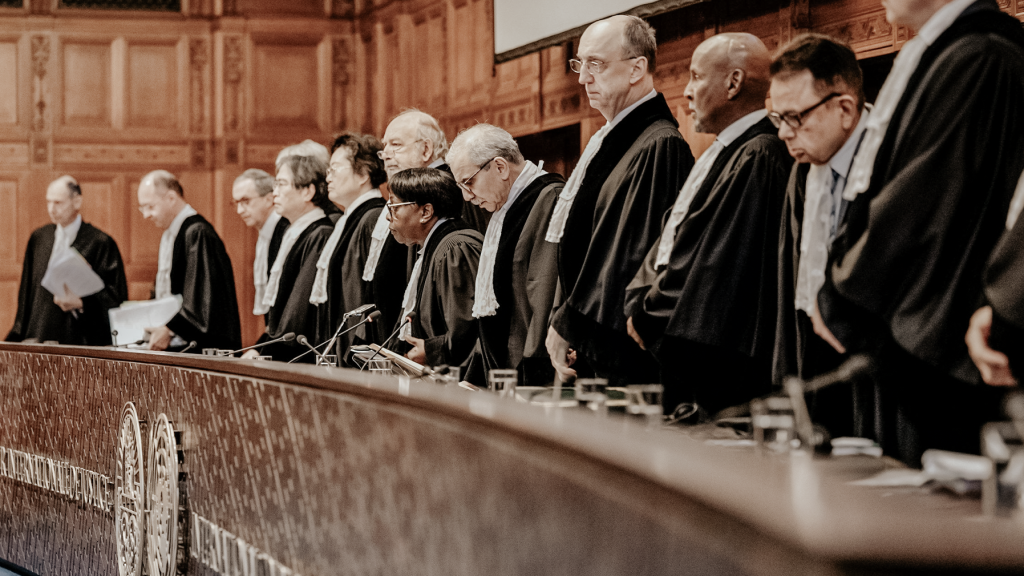
As young leaders from the world’s most climate-vulnerable nations, we see the International Court of Justice’s (ICJ) advisory opinion not only as a legal milestone but as a generational breakthrough. It confirms what youth advocates have long asserted: that states carry binding obligations under international law to protect the climate system for both current and future generations.
This ruling strengthens the legal foundation of our calls for accountability, equity, and urgent action. It is a tool for advocacy, a safeguard for our futures, and a challenge to the narrow interpretations that have too often stalled climate negotiations.
By clarifying the interlinkages between the UN Framework Convention on Climate Change (UNFCCC), the Kyoto Protocol, and the Paris Agreement, the ICJ makes it harder for states to evade responsibility or cherry-pick commitments. Moving forward, governments can no longer interpret these treaties in isolation or use ambiguity to delay climate action.
The Advisory Opinion, sparked by a youth-led initiative from the Pacific Islands, marks a significant turning point in the global climate justice movement. It underscores the moral clarity and leadership of young people in shaping international climate conversations and advancing a vision for a more just and equitable future.
Far beyond the role of advocates, they are actively influencing legal and systemic approaches to climate action. For many young climate activists, the ruling’s emphasis on intergenerational equity is especially significant as it reinforces the idea that today’s inaction poses a real threat to the rights and futures of generations to come.
Crucially, the ICJ cites Nationally Determined Contributions (NDCs) as expressions of a country’s legal obligations to meet the 1.5°C target, not merely as discretionary political commitments. For too long, the NDC process has enabled states to set targets without consequences for non-compliance. With the new ruling, failure to prevent foreseeable and serious climate harm could amount to a breach of international obligations; hence, opening space for stronger compliance mechanisms and legal advocacy by civil society.
The Advisory Opinion reaffirms the principle of common but differentiated responsibilities, reinforcing calls for scalable, fair, predictable, accessible, and transparent climate finance. It stands as a compelling legal and moral reference—one that strengthens calls for accountability, challenges delays, and supports policy-making that prioritizes long-term responsibility.
Stronger legal grounds for CVF-V20 nations
The ICJ’s decision highlights the importance of scaling up climate finance for vulnerable states like Uganda and the Philippines.
In Uganda, which is in the process of developing its Third NDC under the Paris Agreement, the ICJ’s opinion provides a compelling foundation to anchor and elevate its climate ambition. It offers legal weight to advocate for both domestic implementation and international support.
In the Philippines, the legal frameworks and scientific basis for climate action already exist. The challenge lies in enforcement. Bridging this gap requires resourcing climate-related efforts, from geohazard assessments to fossil fuel reduction, at the local level. With political will and alignment with the ICJ’s guidance, implementation can catch up to the country’s ambitious climate policies and targets.
In Ethiopia, which contributes less than 0.03% of global emissions, the advisory opinion lends legal force to the long-standing call for climate justice. It reinforces the credibility of global frameworks while giving more weight to national commitments such as Ethiopia’s Climate Resilient Green Economy strategy and its NDC, which ambitiously targets a 68.8% reduction in emissions by 2030.
In Malawi, the ruling underscores the need for institutionalizing innovative approaches such as climate debt swaps, the Fossil Fuel Non-Proliferation Treaty, and cap-and-share mechanisms. These strategies, grounded in the polluter pays principle and aligned with the CVF-V20’s Ten Super Levers of Climate Action, can help operationalize justice-centered climate solutions.
Road to COP30
This legal recognition is expected to reshape the negotiation dynamics at the 30th Conference of the Parties to the United Nations Framework Convention on Climate Change (COP30), especially on mechanisms like the New Collective Quantified Goal (NCQG), Fund for Responding to Loss and Damage Fund (FRLD), and Adaptation Fund.
The Advisory Opinion reframes the long-standing pattern of unfulfilled pledges and delayed promises from past climate conventions as matters of injustice, lending powerful legal and moral weight to the growing calls for a more ambitious NCQG to be governed by legally grounded criteria. Perhaps no mechanism is more directly affected than the FRLD which has often been approached as a question of goodwill or moral responsibility. The ICJ opinion shifts that paradigm, recognizing loss and damage finance as a legal obligation, not just a discretionary act.
The ruling serves as negotiation leverage in COP30, giving the world’s climate-vulnerable a quasi-legal reference point to cite when pushing back against high-emitting countries. By stating that states must adopt mitigation and adaptation measures consistent with the best available science and equity, the advisory opinion raises the normative stakes of inaction. While formal legal enforcement remains limited, the reputational consequences of non-compliance are now more significant and harder to ignore.
The ruling is expected to carry significant weight in guiding the formulation of national and local policies moving forward. It gives legal grounding to the youth-led push for stronger legislation, better implementation, and more ambitious climate goals.
More than a milestone in the climate space, the ICJ Advisory Opinion is another call-to-action urging the youth to persist and organize change on the ground. With international law now reinforcing the legitimacy of climate movements, young people have gained a renewed platform and a stronger mandate to lead the charge toward climate justice.
***
Contributing CVF Youth Fellows:
Fe Esperanza Trampe, Legal Officer, Environmental Legal Assistance Center, Inc., Philippines
Hala Al-Hamawi, PhD Candidate, Social and Political Sciences Department, Nottingham Trent University, Jordan
Keith Sigfred Ancheta, Junior Policy Specialist, Parabukas, Philippines
Ninna Catipon, Climate Justice Activist, Philippines
Ramsha Malik, Assistant Director (Capacity Building), Ministry of Climate Change and Environmental Coordination, Pakistan
Sara Badran, Research Coordinator, American University of Beirut – Nature Conservation Center, Lebanon
Tarcizio Kalaundi, Programme Officer, Resilience and Livelihood-Trocaire Malawi
Victoria Kinobe Nakatudde, Water Officer, Ministry of Water and Environment, Uganda
Yordanos Getachew Kasahun, Senior Sustainability and Certification Officer at Kerchanshe Group, The Youth Print, Ethiopia