
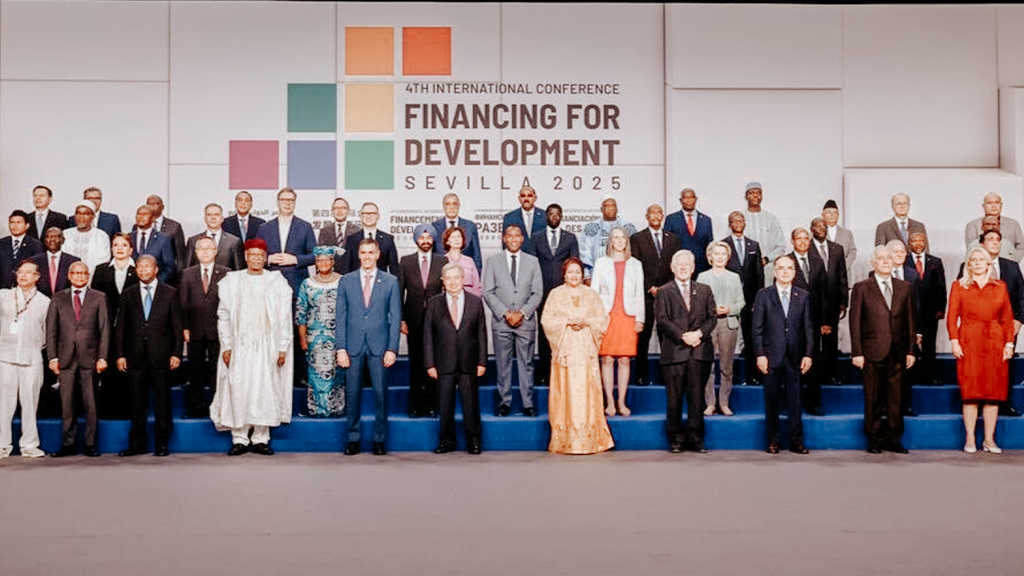
July 15, 2025—The 4th International Conference on Financing for Development (FfD4), held in Seville, Spain from June 30 to July 3, aimed to re-energize global commitments to financing the Sustainable Development Goals (SDGs). Bringing together political leaders, international organizations, development banks, the private sector, and civil society, the conference unfolded at a critical juncture characterized by converging climate and development crises that disproportionately affect climate-vulnerable economies.
The outcome of the conference, the Compromiso de Sevilla, reflects a comprehensive ambition. However, its final form lands more as a “catch-all” than a catalyst. Many of the issues featured, namely debt sustainability, concessional finance, multilateral development bank (MDB) reform, and trade, have been on the agenda for more than a decade, echoing themes from the previous FfD conferences in Monterrey and Addis Ababa.
Reaffirmation has value, particularly in a multilateral setting. But for the Climate Vulnerable Forum and V20 Finance Ministers (CVF-V20), reaffirmation is not progress. Our countries can no longer afford another decade of déjà vu. There is an urgent need for specificity, accountability, and time-bound mechanisms for reform and delivery.
What did the CVF-V20 expect?
Coming into Seville, the CVF-V20 expected a more honest reckoning with structural failures in the global financial system. We sought explicit recognition of the needs of climate-vulnerable economies not just in generic terms, but through concrete reforms that reflect the realities of climate risk, resilience, and fiscal strain. We hoped the conference would highlight debt sustainability as a climate issue, support concessional finance tailored to vulnerability, and endorse new financial instruments like Climate Resilient Debt Clauses (CRDCs). We also expected stronger support for country-led platforms like Climate Prosperity Plans (CPPs), which integrate fiscal, development, and climate strategies to drive resilience and growth.
While the outcome document did not meet all these expectations, there were some notable bright spots. It includes stronger language around aligning public finance and national budgets with climate goals, signaling a growing understanding of the climate-development nexus. We were encouraged by the recognition that concessionality should be based not solely on income levels but also on vulnerability, an important shift toward a more equitable financial architecture. There was also an emerging consensus on the need for risk-informed financial instruments, which, although underdeveloped in the document, creates a foundation for future advocacy.
What did we get?
The conference also produced a Seville Platform of Action, which outlines a set of priority initiatives intended to translate commitments into practice. This platform emphasizes the need for systemic transformation in development finance, including measures to strengthen national capacities, improve access to long-term concessional finance, and enhance public–private cooperation. While largely aspirational, it offers a potential roadmap for follow-up efforts particularly around operationalizing country-led strategies, scaling sustainable finance innovations, and improving the quality (not just quantity) of development finance flows.
These positives were, however, overshadowed by the absence of concrete commitments and the prevalence of best-endeavour language across many sections of the Compromiso, falling short of the decisive and time-bound reforms climate-vulnerable countries urgently need.
Despite the years of advocacy, there were no binding announcements on MDB reform or timelines for scaling up concessional finance. CPPs, which are already being implemented in several CVF-V20 countries as integrated frameworks for resilience-building, require formal mention. Language around private capital mobilization remained vague, with little attention to the real barriers such as high cost of capital and currency risk that prevent investment in climate-vulnerable economies.
Most disappointing was the absence of any endorsement to scale successful innovations like CRDCs, which countries like Barbados, Grenada, and Saint Vincent and the Grenadines have already demonstrated to be viable. It is worth mentioning that a number of entities, such as the Government of Spain, have actively pushed for the increased uptake and enhancement of CRDCs.
One area of particular interest for the CVF-V20 is concessional finance. For our economies, concessionality is not about charity; rather, it represents justice. It is about aligning the international financial system with the reality that climate-vulnerable countries are paying a premium for a crisis they did not create. The Compromiso de Sevilla made welcome reference to the idea of tailoring concessional finance to vulnerability in 48 (e) which explicitly states that Parties agree to “increase access to concessional finance by integrating vulnerability in efforts to enhance debt sustainability and development support” but the next step must be to institutionalize this principle. ‘Concessionality for climate resilience’ must be embedded in MDB capital frameworks and in the design of IMF-supported programs. This is a defining issue of global equity.
The recognition of country-led platforms as models of cooperation was another small but significant win. While CPPs were not directly named, the idea of platforms that enhance coordination, unlock investment, and build local capacity was echoed throughout the conference. For the CVF-V20, CPPs are cost-free to governments, serve as fiscal and investment roadmaps, and provide clarity for public and private partners. They are a vital tool for integrating climate goals into national development strategies.
Additionally, a coalition of wealthy creditor nations and multilateral lenders—including Spain—launched the Debt Suspension Clause Alliance. The initiative advocates for the systematic inclusion of debt suspension clauses in public and commercial lending agreements. These clauses would enable temporary pauses in sovereign debt payments during climate shocks, humanitarian crises, or other extraordinary events like natural hazards, food shortages, health emergencies, and potentially armed conflict, as noted by Spain’s Foreign Minister.
Spanish Economy Minister Carlos Cuerpo emphasized the rationale as the creation of immediate fiscal space during crises, enabling affected countries to redirect resources toward emergency response and recovery without jeopardizing debt solvency or essential social spending.
This initiative reflects growing momentum for climate- and crisis-responsive financing tools as part of broader reforms in the global financial architecture. The initiative is co-led by the governments of Canada, France, and the United Kingdom, alongside key multilateral development banks, including the Inter-American Development Bank, European Investment Bank, African Development Bank, Development Bank of Latin America and the Caribbean (CAF), and the Asian Development Bank. Notably, Deutsche Bank has become the first private financial institution to join the alliance, signaling a potentially broader shift toward crisis-responsive lending norms across both public and private sectors.
On the flipside, FfD4 also underscored persistent challenges. There remains a troubling disconnect between political ambition and institutional delivery. Most governments seemingly came without the intention to make announcements on implementation. Civil society and vulnerable countries continue to face power imbalances in decision-making spaces. Additionally, trust in multilateralism is eroding.
There is also a deeper misperception among parts of the global public that basic development needs such as water access or transport infrastructure are already universally available. FfD4 made clear that this is far from the truth. Development finance is not abstract. Rather, it is about improving the lives of real people in real communities.
Despite these tensions, the conference left us with several opportunities. There is growing awareness that climate and development finance are not separate agendas. Climate action is development done differently. There is also increasing openness to country leadership, including through national development banks and public capital institutions. Articles 30(a) and 30(b) of the outcome document may serve as conduits to increase the roles of National Development Banks in mobilizing resources for sustainable development. MDBs and development partners are also encouraged “to enhance efforts to provide long-term, low-cost financing to invest in sustainable development.” The Compromiso de Sevilla, for all its limitations, offers a space to push for operational reform, not just more money, but better-aligned, better-structured finance.
What is next?
As we move forward, the CVF-V20 will continue to extend support to finance ministers, foster South–South cooperation, and advocate for practical solutions such as debt-for-climate swaps, enhanced investment strategies for resilience, and stronger fiscal capacity to reduce debt burdens. We will also push to evolve how we evaluate sustainable development not by outputs alone, but by the transformational impact on people’s lives.
Compromiso de Sevilla is both a reflection of progress and a reminder of how far we still have to go. It shows that the spirit of multilateralism is alive, but flickering. The real test is whether consensus can be transformed into action, that is, action that delivers for the climate-vulnerable, strengthens trust in the international system, and builds a truly inclusive financial architecture.
As the CVF-V20 has consistently advocated, it is time for real transformation.
***