
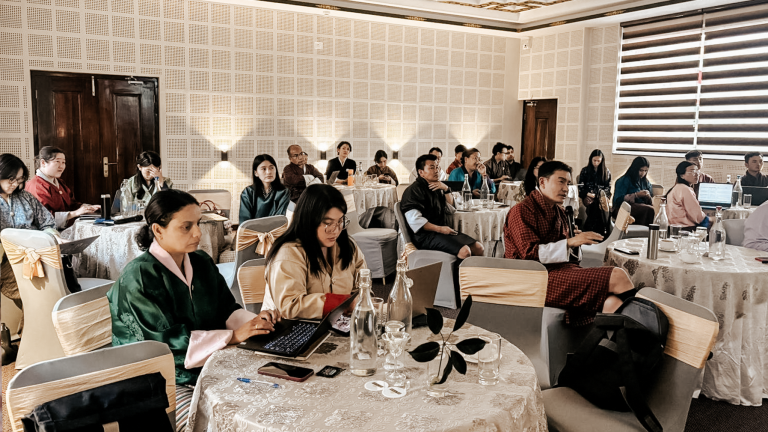
Thimphu, Bhutan | July 18, 2025—Over 40 participants from key national government agencies, ministries, financial institutions, civil society, the private sector, and academia convened at the Tashi Yid-Wong Grand in Thimphu, Bhutan, on July 16 and 17 for a Consultation, Data Validation, and Capacity Building Workshop on Carbon Market Readiness.
The workshop was organized by the Department of Environment and Climate Change (DECC) under the Ministry of Energy and Natural Resources (MoENR), in partnership with the Climate Vulnerable Forum and V20 Finance Ministers (CVF-V20) Secretariat. The event aimed to foster inclusive, multi-sectoral dialogue; validate essential data for carbon market readiness; and build the capacity of stakeholders across sectors—laying the foundation for a coordinated and strategic approach to Bhutan’s engagement in carbon markets.
“Capacity building for carbon markets is not just timely-it is essential. With international negotiations on Article 6 of the Paris Agreement concluded in Baku last year and with growing interest from countries and investors, Bhutan must be ready. This workshop marks an important step in equipping our institutions with the knowledge and tools to develop robust policies, credible infrastructure, and high-integrity carbon credits that can contribute meaningfully to global climate goals while unlocking new climate finance opportunities for Bhutan,” said DECC Director Sonam Tashi.
Bhutan is making steady progress toward establishing key institutional and technical infrastructure such as the Bhutan Climate Fund (BCF) and is finalizing its Carbon Market Rules 2023, National Carbon Registry, and the initiation of bilateral cooperation with Singapore. These efforts underscore the country’s strong commitment to transforming its emission reduction assets into economic revenue streams that support sustainable development.
The workshop combined technical training, stakeholder consultation, and strategic planning to support Bhutan’s participation in carbon markets, particularly under Article 6 of the Paris Agreement, as well as in compliance and voluntary carbon markets.
On the first day, discussions focused on global climate finance trends, national policy developments, and the mechanics of carbon markets, including Article 6 of the Paris Agreement. Interventions centered on the possible tools and financing instruments available for various sectors to access climate finance from different funding entities. A keynote intervention by Professor Lisa Sachs from Columbia University emphasized how Bhutan, as a carbon-negative country, can strategically engage with emerging opportunities to leverage climate finance for sustainable development.
The second day was hands-on, with sector-specific working groups (energy, transport, agriculture, waste) validated data and mapped mitigation opportunities. Participants estimated potential greenhouse gas reductions and carbon revenue, providing inputs into Bhutan’s forthcoming NDC 3.0 and national carbon market roadmap.
Key discussions centered on the development of a practical “Carbon Market Playbook” to guide the private sector through project preparation, authorization, benefit-sharing, and access to finance.
In her remarks, CVF-V20 Managing Director Sara Jane Ahmed emphasized that the insights gathered in the workshop will shape Bhutan’s roadmap carbon market development, including policy recommendations, capacity-building plans, and a pipeline of projects both in compliance and voluntary carbon markets. “The CVF-V20 is committed to working hand-in-hand with all stakeholders to advance Bhutan’s carbon market strategy and ensure it leads to meaningful and equitable outcomes for the Bhutanese people,” she said.
***
The CVF-V20 represents 74 member-countries from small island developing states (SIDS), least developed countries (LDCs), low-to-middle income countries (LMICs), landlocked developing countries (LLDCs), and fragile and conflict-affected states (FCS). Working together, the CVF-V20 aims to achieve climate justice through the realization of Climate Prosperity Plans, which contain ambitious economic and financial resilience strategies designed to attract investment and resources that advance the attainment of the Sustainable Development Goals (SDGs), 30×30 Global Biodiversity, and help keep the average global temperatures to the Paris Agreement’s 1.5°C safety threshold.
For media enquiries, please contact [email protected].
For the latest updates, please follow us on:
Africa: Benin, Burkina Faso, Cabo Verde, Chad, Comoros, Côte d’Ivoire, Democratic Republic of the Congo, Eswatini, Ethiopia, Gabon, The Gambia, Ghana (Troika), Guinea, Kenya, Liberia, Madagascar, Malawi, Morocco, Mozambique, Namibia, Niger, Rwanda, Senegal, Sierra Leone, Somalia, South Sudan, Sudan, Tanzania, Togo, Tunisia, Uganda
Asia: Afghanistan, Bangladesh (Troika), Bhutan, Cambodia, Kyrgyzstan, Maldives, Mongolia, Nepal, Pakistan, Philippines, Sri Lanka, Timor-Leste, Vietnam
Caribbean: Barbados (Chair/Troika), Dominica, Dominican Republic, Grenada, Guyana, Haiti, Saint Lucia, Suriname, Trinidad and Tobago
Latin America: Colombia, Costa Rica, Guatemala, Honduras, Nicaragua, Paraguay
Middle East: Jordan, Lebanon, Palestine, Yemen
Pacific: Fiji, Kiribati, Marshall Islands, Nauru, Palau, Papua New Guinea, Samoa, Solomon Islands, Tonga, Tuvalu, Vanuatu