
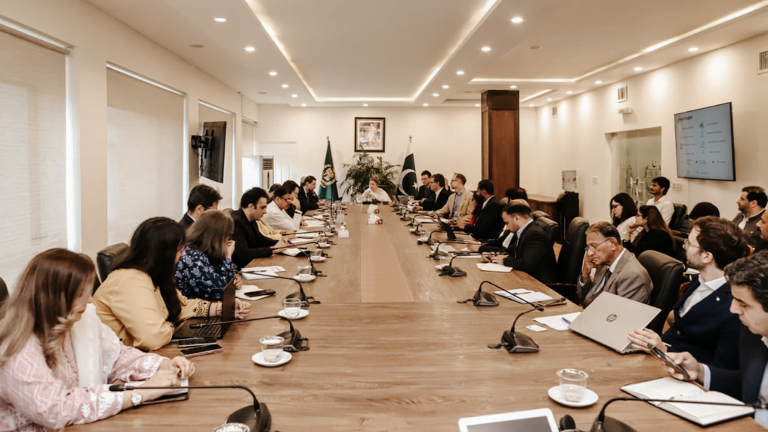
Islamabad, Pakistan | July 16, 2025—The Climate Vulnerable Forum and V20 Finance Ministers (CVF-V20) Secretariat participated in the High-Level National Dialogue on Pakistan’s Nationally Determined Contribution (NDC) 3.0 on July 15.
CVF Regional Director for South Asia Hamza Haroon and Pakistan Climate Prosperity Plan (CPP) Lead Anam Rathor updated stakeholders on the progress of Pakistan CPP development, stressing the importance of connecting climate ambition with investment-readiness. They highlighted a range of crucial tools to achieve this, including green bonds and creditworthy project pipelines to investor pitch decks and carbon market mechanisms.
They also emphasized the need for scenario-based planning in line with the upcoming COP30 Presidency and reaffirmed their collaboration with the Ministry of Climate Change & Environmental Coordination (MoCC&EC) and the Ministry of Finance.
Updated NDC targets
Chaired by Secretary Aisha Humera, the event focused on integrating scientific evidence, fiscal strategy, and institutional innovation into the climate policy framework.
Mr. Arif Goheer, Managing Director of the Global Climate Change Impact Studies Centre (GCISC), presented the technical outlook, citing a sobering statistic: 167 climate-related disasters over the past 25 years. He also detailed Pakistan’s updated 2030 targets: a 50% emissions reduction (15% unconditional, 35% conditional), supported by transitions in the energy, transport, and agriculture sectors.
Provincial projects and new initiatives
A robust pipeline of provincial projects was also shared, featuring GIS-based vulnerability mapping, smart metering systems, and adaptation efforts in agriculture and water management. Key instruments, including the RiSO platform and climate finance dashboards, were showcased to strengthen monitoring, reporting, and verification (MRV) systems.
In her remarks, Secretary Humera committed to advancing the NDC process through whole-of-society engagement, institutional capacity building, and increased transparency. She underscored Pakistan’s urgent need for climate financing, referencing the World Bank’s Country Climate and Development Report (CCDR) estimate of USD350 billion required by 2030. She highlighted recent progress, including a USD1.3 billion climate-tagged project portfolio and a forthcoming youth climate innovation challenge.
This dialogue marks a critical milestone in aligning Pakistan’s climate ambition with pathways to resilience and prosperity. CVF-V20 remains committed to fostering investment-ready, action-oriented partnerships that deliver both national and global impact.
***
The CVF-V20 represents 74 member-countries from small island developing states (SIDS), least developed countries (LDCs), low-to-middle income countries (LMICs), landlocked developing countries (LLDCs), and fragile and conflict-affected states (FCS). Working together, the CVF-V20 aims to achieve climate justice through the realization of Climate Prosperity Plans, which contain ambitious economic and financial resilience strategies designed to attract investment and resources that advance the attainment of the Sustainable Development Goals (SDGs), 30×30 Global Biodiversity, and help keep the average global temperatures to the Paris Agreement’s 1.5°C safety threshold.
For media enquiries, please contact [email protected].
For the latest updates, please follow us on:
Africa: Benin, Burkina Faso, Cabo Verde, Chad, Comoros, Côte d’Ivoire, Democratic Republic of the Congo, Eswatini, Ethiopia, Gabon, The Gambia, Ghana (Troika), Guinea, Kenya, Liberia, Madagascar, Malawi, Morocco, Mozambique, Namibia, Niger, Rwanda, Senegal, Sierra Leone, Somalia, South Sudan, Sudan, Tanzania, Togo, Tunisia, Uganda
Asia: Afghanistan, Bangladesh (Troika), Bhutan, Cambodia, Kyrgyzstan, Maldives, Mongolia, Nepal, Pakistan, Philippines, Sri Lanka, Timor-Leste, Vietnam
Caribbean: Barbados (Chair/Troika), Dominica, Dominican Republic, Grenada, Guyana, Haiti, Saint Lucia, Suriname, Trinidad and Tobago
Latin America: Colombia, Costa Rica, Guatemala, Honduras, Nicaragua, Paraguay
Middle East: Jordan, Lebanon, Palestine, Yemen
Pacific: Fiji, Kiribati, Marshall Islands, Nauru, Palau, Papua New Guinea, Samoa, Solomon Islands, Tonga, Tuvalu, Vanuatu